 ChessPigeon
How to Analyze Your Chess Games
To analyze a chess game, recall your thinking, find the turning points, compare candidate moves, test an alternative and record one lesson. Use ChessPigeon's Stockfish review to check your ideas. This guide works through all five steps using Morphy's Opera Game.
Why review your own games
Reviewing your own games is the most direct way to improve, because it targets the mistakes you actually make. The trap is letting the engine do all the thinking: you scroll through the red marks, nod, and forget them by the next game.
The method below keeps you in charge. You think first, use Stockfish to check your thinking, and finish with one idea you can take into your next game.
The example: Morphy's Opera Game
We'll use Paul Morphy's Opera Game, played in Paris in 1858 against the Duke of Brunswick and Count Isouard, who consulted on their moves. It is short, instructive and more than 160 years old. It's also the sample game built into ChessPigeon.
Imagine you had the black pieces. You lost in 17 moves, and you want to know what went wrong.
Open the Opera Game in ChessPigeon (opens in a new tab)
The link opens the game in a new tab. It doesn't replace anything you have open or change your saved games.
1. Recall your own thinking first
Before you switch on the engine, play through the game and write down two or three moments where you felt unsure, made a quick decision or missed something your opponent did. Those notes are the most valuable part of the review, because they show how you were thinking during the game.
As Black in the Opera Game, one such moment comes after 7. Qb3. The queen attacks the pawn on b7, and together with the bishop on c4 it also aims at f7. Did you notice both threats? The game continued 7... Qe7. It defends f7 and meets 8. Qxb7 with 8... Qb4+, offering a queen trade, but it blocks the bishop on f8.
2. Find the turning points
Now open the game in ChessPigeon and select Analyze game. When the review finishes, look at the evaluation graph. It plots the evaluation from White's perspective, and the coloured dots mark inaccuracies, mistakes and blunders. A steep change in the line is a turning point. Click it to jump straight to that position.
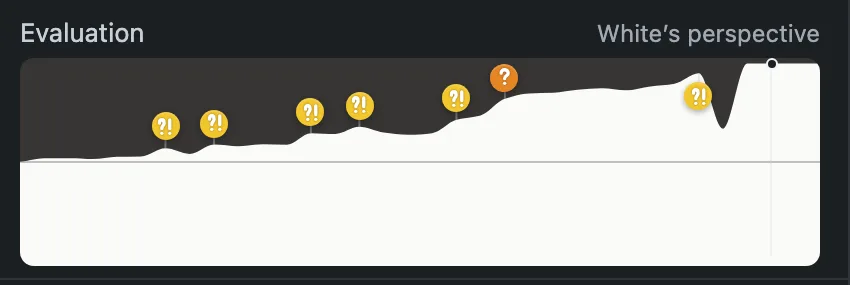
In our review at the default Balanced depth, Black's critical moments were:
| Move | Label | Evaluation after the move |
|---|---|---|
| 3... Bg4 | Inaccuracy | +1.1 |
| 4... Bxf3 | Inaccuracy | +1.4 |
| 6... Nf6 | Inaccuracy | +2.4 |
| 7... Qe7 | Inaccuracy | +3.0 |
| 9... b5 | Inaccuracy | +3.6 |
| 10... cxb5 | Mistake | +6.0 |
| 14... Qe6 | Inaccuracy | +11.3 |
Overall, Morphy scored 80.5% accuracy and the Duke and Count 61.9%. Your numbers can differ slightly with other depth settings or engine versions. Treat them as a guide to where to look, not a verdict.
3. Compare candidate moves
Pick the turning point that matters most, and before you look at the engine lines, list the moves you would consider there. Then compare them with Stockfish's.
Take the position after 9. Bg5. Black played 9... b5, trying to chase the bishop from c4. With Engine lines set to three, Stockfish's top choices at depth 14 were:
| Candidate | Evaluation | Idea |
|---|---|---|
| 9... Qc7 | +2.4 | Moves the queen off e7, so the knight on f6 is no longer pinned to it |
| 9... Na6 | +2.6 | Finally develops the queenside knight |
| 9... a6 | +2.9 | Supports a later ...b5 with the a-pawn |
| 9... b5 | +3.6 (played) | Attacks the bishop, but the pawn can be taken |
None of the alternatives saves Black: White is already clearly better. That is a useful finding in itself. The real damage was done earlier, by spending moves on bishop trades and queen moves instead of developing.
4. Test one alternative
Choose one alternative and play it on the board. In ChessPigeon, making a different move creates a variation. The engine evaluates the new position and the panel shows a ← Return to main line button to get back.
Try 9... Qc7 and play a few moves for both sides. Ask yourself what changed: the bishop on g5 no longer pins the knight on f6 to the queen, and White has no Nxb5 sacrifice because the b-pawn hasn't moved.
Then look at why the game move failed. After 10... cxb5 11. Bxb5+ Nbd7 12. O-O-O, the knight on d7 is pinned to the king by the bishop on b5, and White's rook joins the attack along the d-file.
Test only one or two alternatives. Exploring every engine line turns a review into an endless analysis session and blurs the lesson.
5. Record one lesson
Finish by writing a single sentence you can use in your next game. ChessPigeon doesn't have a notes editor yet, so a notebook or a text file works well. For the Opera Game, Black's lesson might be:
Compare the final position with the start of the attack. White won with a rook and a bishop while Black still had a queen, a rook, a bishop and a knight, because most of Black's pieces never joined the game.
Replay the whole game
Step through the full game with the notes from this review.
Morphy vs Duke of Brunswick & Count Isouard, Paris 1858
- 1.
- 2.
- 3.
- 4.
- 5.
- 6.
- 7.
- 8.
- 9.
- 10.
- 11.
- 12.
- 13.
- 14.
- 15.
- 16.
- 17.
Starting position. Step through the moves.
Try it on your own game
Open your own most recent game, follow the five steps and keep your one-sentence lesson. You can paste a PGN, upload a file or find your Chess.com games by username.
- Recall: write down two or three moments where you were unsure.
- Find the turning points: run Analyze game and read the evaluation graph.
- Compare candidates: list your moves before reading the engine lines.
- Test one alternative: play it on the board as a variation.
- Record one lesson: one sentence for your next game.