 ChessPigeon
Understanding Game Review
Reading the evaluation
Stockfish scores a position in pawns. +1.0 means White is better by roughly a pawn's worth; −1.0 means Black is. Scores near 0.0 mean the position is balanced.
When Stockfish finds a forced checkmate, the score becomes a mate count instead: +M3 means White can mate in three moves, −M3 means Black can. At checkmate itself the score shows #.
Whose point of view?
- Evaluation graph and engine lines always use White's perspective: higher is better for White. The graph header says White's perspective.
- The evaluation bar beside the board follows the board's orientation. If you flip the board to play from Black's side, its number shows Black's point of view.
The evaluation graph
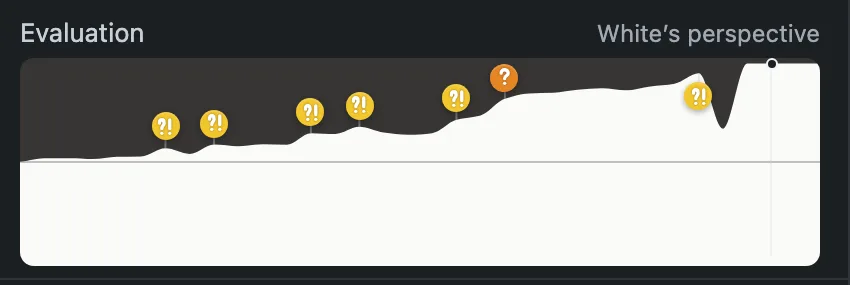
The graph plots the evaluation after every move. A steep drop is where something important happened. By default the graph marks only Brilliant moves, Inaccuracies, Mistakes and Blunders. Click a marker to jump to that move. To see every rating as a coloured dot, turn on All move ratings on graph · colored dots in Settings.
Move labels
Each move is compared with Stockfish's preferred move and labelled by how much of the player's winning chance it gave away, measured in percentage points.
| Label | Meaning |
|---|---|
| Brilliant | Stockfish's best move that deliberately offers a piece, which the opponent's best reply captures. Available at review depth 12 or more. |
| Book | A recognized opening move. |
| Best | Stockfish's top choice at the review depth. |
| Excellent | Lost less than 1 point of winning chance. |
| Good | Lost 1 to 3 points. |
| Inaccuracy | Lost 3 to 7 points. |
| Mistake | Lost 7 to 15 points. |
| Blunder | Lost 15 points or more. |
Example: if your winning chance is 60% before a move and 50% after it, the move lost 10 points and is labelled a Mistake. In an already lost position, even a big drop in pawns may cost few points of winning chance, so it can still be labelled Excellent or Good.
How accuracy is calculated
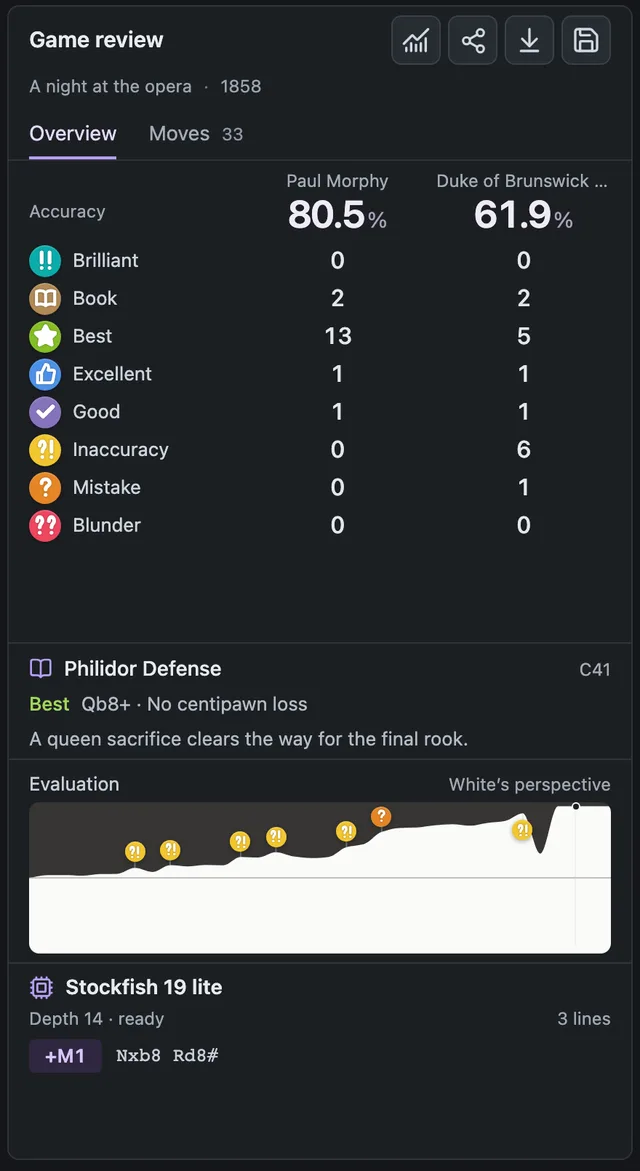
ChessPigeon converts each evaluation into an estimated winning chance, then measures how much each move lost. Accuracy starts at 100% and falls as a player's average loss per move grows: an average loss of 10 points gives about 37%, an average of 2 points about 82%.
This is ChessPigeon's own transparent estimate. Chess.com and other sites use different engines, settings and formulas, so your accuracy there will not match exactly. The tooltip in the app says the same: the score is independent of Chess.com's.
Depth and engine lines
Depth describes how deeply Stockfish searches. Choose it in Settings under Analysis depth:
| Preset | Depth | Good for |
|---|---|---|
| Fast | 10 | Quick checks on slower devices |
| Balanced | 14 | Everyday reviews (the default) |
| Deep | 18 | More reliable results on important games |
| Max | 22 | The most thorough review, and the slowest |
Engine lines sets how many alternative continuations Stockfish shows, from 1 to 5 (3 by default). Click a line to play it on the board and explore it.
Limits of interpretation
- Labels describe one engine's view at one depth. A deeper search can change a few verdicts.
- A “Mistake” in a position you were losing anyway may not have mattered; a small inaccuracy in a balanced endgame might.
- The engine doesn't know what you were thinking. Use the review to find the critical moments, then ask yourself why you chose your move.